
As agriculture has evolved over thousands of years, so have the tools farmers use to raise the crops and livestock that nourish us.
For instance, today we farm with tractors instead of wooden hand tools, and we use computers instead of paper and pen, which allows farmers to track and raise healthier crops and livestock.
Simply, our ability to grow high-quality food has become more precise and continues to evolve as we better understand the needs of farmers, animals, people and the planet. An example of continued progress that can make farmers more precise is a technology called gene editing.
Gene editing allows scientists to make precise edits to a small portion of DNA to eliminate disease or repair damaged cells. While these edits happen at a microscopic level, they have the potential to make a significant positive impact on our world.
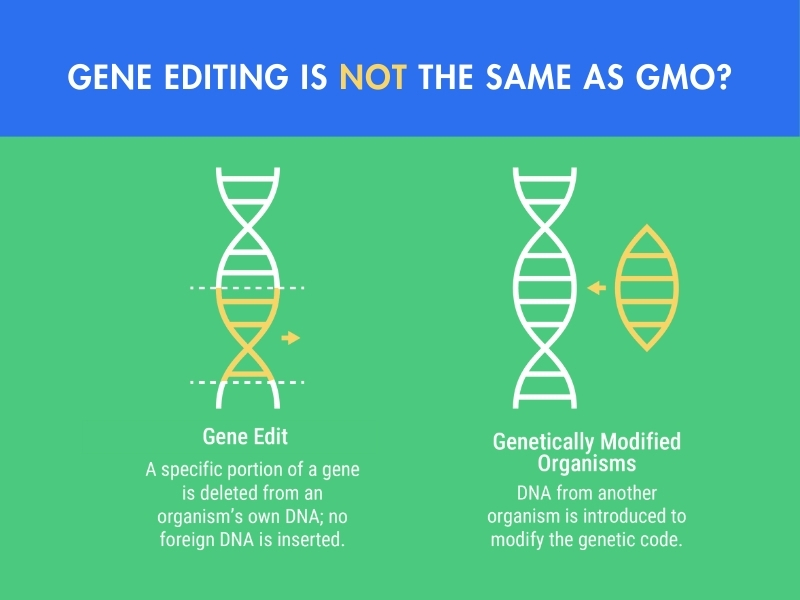
Gene editing is typically not the same thing as traditional genetically modified organisms, also known as GMOs. But what is the difference?
Typically in gene editing, nothing foreign is added. The edit happens on a microscopic level by precisely deleting a specific portion of DNA, which can lead to reducing illness in animals or make crops tastier and more nutritious.
Unlike gene editing, GMOs are created by introducing foreign DNA to modify the genetic code.
“As someone that’s worked in the field of genetics for over 30 years, I think gene editing is an exciting development because it allows you a lot more precision in terms of where you’re able to make alterations in the genome,” said geneticist Dr. Alison Van Eenennaam, Professor of Cooperative Extension in Animal Biotechnology and Genomics at UC Davis.
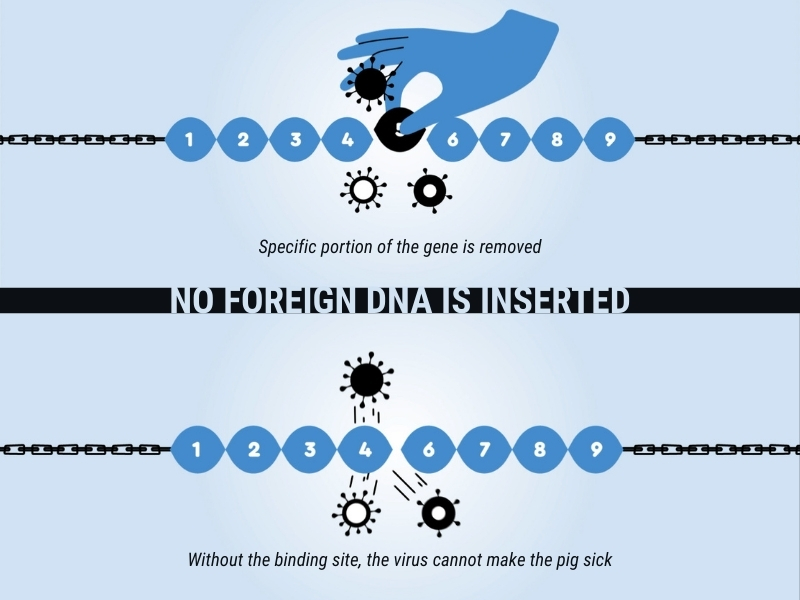
A good example of gene editing is the PRRS-resistant pig. To breed pigs that are resistant to a devastating swine disease called PRRS, scientists precisely removed a portion of a specific gene that the PRRS virus uses to infect the pig. Nothing foreign was added and no genes were inserted.
Think of the genetic entry point like a necklace with nine beads. The virus can only attach to one specific bead, the fifth bead. If we remove this bead, the virus has nowhere to connect to, protecting the pig from infection. The result is PRRS-resistant pigs. This isn’t a change to the pork, it’s a change to how pigs are protected from a devastating disease.
And this doesn’t mean pigs are raised in a lab. Rather, like humans inherit eye color from their parents and grandparents, pigs inherit resistance to the PRRS virus through traditional breeding, all thanks to the original gene-edit that was made years ago.
“What does gene editing really do? Well, it enables you to go in and focus on specific genes in the genome and potentially inactivate them or turn them off so that they don’t produce a protein that creates an otherwise undesirable effect,” said Dr. Van Eenennaam.
Studies have shown that gene editing can be used responsibly to protect pigs from the PRRS virus. And by removing PRRS, we can also improve animal welfare, reduce the need for antibiotics and the environmental impact.
“Now, I realize I’m a geneticist, but I think that genetic disease resistance is a better way to approach this disease than having sick animals or needing to vaccinate them every year or other non-permanent solutions to this problem,” said Dr. Van Eenennaam.
There are currently more than 500 gene-edited crops under development worldwide. Gene editing is being used to achieve disease resistance, improve nutritional content, eliminate seeds in produce, make crops more tolerant to drought and reduce food waste – all without adding any foreign DNA.
Both gene editing and GMOs can be used in modern agriculture, but the difference between the two technologies is an important one.
Gene editing is a new tool that is already offering breakthrough solutions for animals, farmers, people and the planet.
Sources:
- Burger, B. T., Beaton, B. P., Campbell, M. A., Brett, B. T., Rohrer, M. S., Plummer, S., Barnes, D., Jiang, K., Naswa, S., Lange, J., Ott, A., Alger, E., Rincon, G., Rounsley, S., Betthauser, J., Mtango, N. R., Benne, J. A., Hammerand, J., Durfee, C. J., … Cigan, A. M. (2024). Generation of a Commercial-Scale Founder Population of Porcine Reproductive and Respiratory Syndrome Virus Resistant Pigs Using CRISPR-Cas. The CRISPR Journal, 7(1), 12–28. https://doi.org/10.1089/CRISPR.2023.0061
- Asmamaw M, Zawdie B. Mechanism and Applications of CRISPR/Cas-9-Mediated Genome Editing. Biologics. 2021 Aug 21;15:353-361. doi: 10.2147/BTT.S326422. Erratum in: Biologics. 2025 Dec 27;19:745-746. doi: 10.2147/BTT.S585961. PMID: 34456559; PMCID: PMC8388126.
- Phillips, T. (2008) Genetically modified organisms (GMOs): Transgenic crops and recombinant DNA technology. Nature Education 1(1):213. https://www.nature.com/scitable/topicpage/genetically-modified-organisms-gmos-transgenic-crops-and-732/
- Ahmad A, Jamil A, Munawar N. GMOs or non-GMOs? The CRISPR Conundrum. Front Plant Sci. 2023 Oct 9;14:1232938. doi: 10.3389/fpls.2023.1232938. PMID: 37877083; PMCID: PMC10591184.
- Bullion A, Malhotra B. Gene-edited crops market growth spurred by regulatory progress and approvals | S&P Global. Accessed November 30, 2025.
- Nesbitt C, Galina Pantoja L, Beaton B, et al. Pigs lacking the SRCR5 domain of CD163 protein demonstrate heritable resistance to the PRRS virus and no changes in animal performance from birth to maturity. Front Genome Ed. 2024;6:1322012. Published 2024 Mar 13. doi:10.3389/fgeed.2024.1322012
- No difference in flavor, tenderness and juiciness, per Texas A&M AgriLife Research Consumer Sensory Panel – PRRS Resistant Pig. (n.d.). Retrieved July 14, 2026, from https://www.prrsresistantpig.com/2026/07/10/no-difference-in-flavor-tenderness-and-juiciness-per-texas-am-agrilife-research-consumer-sensory-panel/
- Porcine reproductive and respiratory syndrome – WOAH – World Organisation for Animal Health. (n.d.). Retrieved November 23, 2025, from https://www.woah.org/en/disease/porcine-reproductive-and-respiratory-syndrome/
- Holtkamp, Derald. Assessment of the Economic Impact of Porcine Reproductive and Respiratory Syndrome Virus on U.S. Pork Producer – NPB #10-158. https://www.porkcheckoff.org/wp-content/uploads/2021/02/10-158-HOLTKAMP-ISU.pdf. July 25, 2011
- Machado, I., Petznick, T., Poeta Silva, A. P. S., Wang, C., Karriker, L., Linhares, D. C. L., & Silva, G. S. (2024). Assessment of changes in antibiotic use in grow-finish pigs after the introduction of PRRSV in a naïve farrow-to-finish system. Preventive Veterinary Medicine, 233, 106350. https://doi.org/10.1016/J.PREVETMED.2024.106350
- Thoma GJ, Baker B, Knap PW. A Life Cycle Assessment Study of the Impacts of Pig Breeding on the Environmental Sustainability of Pig Production. Animals (Basel). 2024;14(16):2435. Published 2024 Aug 22. doi:10.3390/ani14162435
MI220